
Chemical Safety Markings
Chemical safety markings
On this page you will find explanations of the current markings used on product labels and safety data sheets: GHS hazard pictograms, signal words, H statements, EUH statements and P statements.
GHS hazard pictograms
Only those pictograms that result from the classification of a specific substance or mixture are placed on the product label. Not every chemical product will carry all symbols.
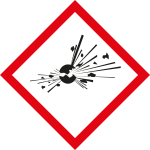
Explosive
- explosives
- self-reactive substances and mixtures, types A and B
- organic peroxides, types A and B
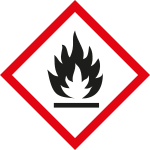
Flammable
- flammable gases, aerosols, liquids and solids
- self-reactive substances
- self-heating substances
- substances which emit flammable gases in contact with water
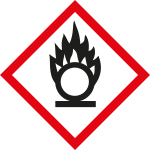
Oxidising
- oxidising gases
- oxidising liquids
- oxidising solids
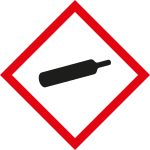
Gas under pressure
- compressed gases
- liquefied gases
- refrigerated liquefied gases
- dissolved gases
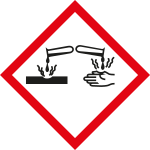
Corrosive
- causes severe skin burns
- causes serious eye damage
- may be corrosive to metals
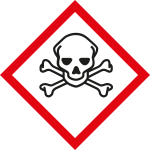
Acute toxicity
- acute toxicity if swallowed
- acute toxicity in contact with skin
- acute toxicity if inhaled
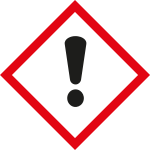
Irritant or harmful
- skin and eye irritation
- skin sensitisation
- acute toxicity category 4
- respiratory tract irritation
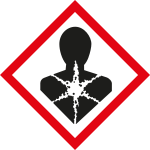
Serious health hazard
- carcinogenicity
- mutagenicity
- reproductive toxicity
- respiratory sensitisation
- aspiration hazard
- target organ toxicity
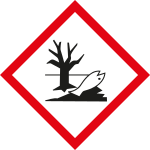
Hazardous to the aquatic environment
- acute aquatic toxicity
- chronic aquatic toxicity
Signal words
The signal word indicates the level of hazard assigned to the product. One of the following two signal words appears on the label:
Used for more severe hazard categories.
Used for less severe hazard categories.
H, EUH and P statements
Below you will find a summary of the markings currently used on product labels and in safety data sheets. You can search by code or part of the text.
| Code | Text |
|---|---|
| H200 | Unstable explosives. |
| H201 | Explosive; mass explosion hazard. |
| H202 | Explosive; severe projection hazard. |
| H203 | Explosive; fire, blast or projection hazard. |
| H204 | Fire or projection hazard. |
| H205 | May mass explode in fire. |
| H206 | Fire, blast or projection hazard; increased risk of explosion if desensitizing agent is reduced. |
| H207 | Fire or projection hazard; increased risk of explosion if desensitizing agent is reduced. |
| H208 | Fire hazard; increased risk of explosion if desensitizing agent is reduced. |
| H220 | Extremely flammable gas. |
| H221 | Flammable gas. |
| H222 | Extremely flammable aerosol. |
| H223 | Flammable aerosol. |
| H224 | Extremely flammable liquid and vapour. |
| H225 | Highly flammable liquid and vapour. |
| H226 | Flammable liquid and vapour. |
| H228 | Flammable solid. |
| H229 | Pressurised container: may burst if heated. |
| H230 | May react explosively even in the absence of air. |
| H231 | May react explosively even in the absence of air at elevated pressure and/or temperature. |
| H232 | May ignite spontaneously if exposed to air. |
| H240 | Heating may cause an explosion. |
| H241 | Heating may cause a fire or explosion. |
| H242 | Heating may cause a fire. |
| H250 | Catches fire spontaneously if exposed to air. |
| H251 | Self-heating: may catch fire. |
| H252 | Self-heating in large quantities; may catch fire. |
| H260 | In contact with water releases flammable gases which may ignite spontaneously. |
| H261 | In contact with water releases flammable gases. |
| H270 | May cause or intensify fire; oxidiser. |
| H271 | May cause fire or explosion; strong oxidiser. |
| H272 | May intensify fire; oxidiser. |
| H280 | Contains gas under pressure; may explode if heated. |
| H281 | Contains refrigerated gas; may cause cryogenic burns or injury. |
| H290 | May be corrosive to metals. |
| H300 | Fatal if swallowed. |
| H301 | Toxic if swallowed. |
| H302 | Harmful if swallowed. |
| H304 | May be fatal if swallowed and enters airways. |
| H310 | Fatal in contact with skin. |
| H311 | Toxic in contact with skin. |
| H312 | Harmful in contact with skin. |
| H314 | Causes severe skin burns and eye damage. |
| H315 | Causes skin irritation. |
| H317 | May cause an allergic skin reaction. |
| H318 | Causes serious eye damage. |
| H319 | Causes serious eye irritation. |
| H330 | Fatal if inhaled. |
| H331 | Toxic if inhaled. |
| H332 | Harmful if inhaled. |
| H334 | May cause allergy or asthma symptoms or breathing difficulties if inhaled. |
| H335 | May cause respiratory irritation. |
| H336 | May cause drowsiness or dizziness. |
| H340 | May cause genetic defects <state route of exposure if it is conclusively proven that no other routes of exposure cause the hazard>. |
| H341 | Suspected of causing genetic defects <state route of exposure if it is conclusively proven that no other routes of exposure cause the hazard>. |
| H350 | May cause cancer <state route of exposure if it is conclusively proven that no other routes of exposure cause the hazard>. |
| H350i | May cause cancer by inhalation. |
| H351 | Suspected of causing cancer <state route of exposure if it is conclusively proven that no other routes of exposure cause the hazard>. |
| H360 | May damage fertility or the unborn child <state specific effect if known> <state route of exposure if it is conclusively proven that no other routes of exposure cause the hazard>. |
| H360F | May damage fertility. |
| H360D | May damage the unborn child. |
| H360FD | May damage fertility. May damage the unborn child. |
| H360Fd | May damage fertility. Suspected of damaging the unborn child. |
| H360Df | May damage the unborn child. Suspected of damaging fertility. |
| H361 | Suspected of damaging fertility or the unborn child <state specific effect if known> <state route of exposure if it is conclusively proven that no other routes of exposure cause the hazard>. |
| H361f | Suspected of damaging fertility. |
| H361d | Suspected of damaging the unborn child. |
| H361fd | Suspected of damaging fertility. Suspected of damaging the unborn child. |
| H362 | May cause harm to breast-fed children. |
| H370 | Causes damage to organs <state all organs affected, if known> <state route of exposure if it is conclusively proven that no other routes of exposure cause the hazard>. |
| H371 | May cause damage to organs <state all organs affected, if known> <state route of exposure if it is conclusively proven that no other routes of exposure cause the hazard>. |
| H372 | Causes damage to organs <state all organs affected, if known> through prolonged or repeated exposure <state route of exposure if it is conclusively proven that no other routes of exposure cause the hazard>. |
| H373 | May cause damage to organs <state all organs affected, if known> through prolonged or repeated exposure <state route of exposure if it is conclusively proven that no other routes of exposure cause the hazard>. |
| H300 + H310 | Fatal if swallowed or in contact with skin. |
| H300 + H330 | Fatal if swallowed or if inhaled. |
| H310 + H330 | Fatal in contact with skin or if inhaled. |
| H300 + H310 + H330 | Fatal if swallowed, in contact with skin or if inhaled. |
| H301 + H311 | Toxic if swallowed or in contact with skin. |
| H301 + H331 | Toxic if swallowed or if inhaled. |
| H311 + H331 | Toxic in contact with skin or if inhaled. |
| H301 + H311 + H331 | Toxic if swallowed, in contact with skin or if inhaled. |
| H302 + H312 | Harmful if swallowed or in contact with skin. |
| H302 + H332 | Harmful if swallowed or if inhaled. |
| H312 + H332 | Harmful in contact with skin or if inhaled. |
| H302 + H312 + H332 | Harmful if swallowed, in contact with skin or if inhaled. |
| H400 | Very toxic to aquatic life. |
| H410 | Very toxic to aquatic life with long lasting effects. |
| H411 | Toxic to aquatic life with long lasting effects. |
| H412 | Harmful to aquatic life with long lasting effects. |
| H413 | May cause long lasting harmful effects to aquatic life. |
| H420 | Harms public health and the environment by destroying ozone in the upper atmosphere. |
| Code | Text |
|---|---|
| EUH 014 | Reacts violently with water. |
| EUH 018 | In use may form flammable or explosive vapour-air mixture. |
| EUH 019 | May form explosive peroxides. |
| EUH 044 | Risk of explosion if heated under confinement. |
| EUH 029 | Contact with water liberates toxic gas. |
| EUH 031 | Contact with acids liberates toxic gas. |
| EUH 032 | Contact with acids liberates very toxic gas. |
| EUH 066 | Repeated exposure may cause skin dryness or cracking. |
| EUH 070 | Toxic by eye contact. |
| EUH 071 | Corrosive to the respiratory tract. |
| EUH 201/201A | Contains lead. Should not be used on surfaces liable to be chewed or sucked by children. Warning! Contains lead. |
| EUH 202 | Cyanoacrylate. Danger. Bonds skin and eyes in seconds. Keep out of the reach of children. |
| EUH 203 | Contains chromium (VI). May produce an allergic reaction. |
| EUH 204 | Contains isocyanates. May produce an allergic reaction. |
| EUH 205 | Contains epoxy constituents. May produce an allergic reaction. |
| EUH 206 | Warning! Do not use together with other products. May release dangerous gases (chlorine). |
| EUH 207 | Warning! Contains cadmium. Dangerous fumes are formed during use. See information supplied by the manufacturer. Comply with the safety instructions. |
| EUH 208 | Contains <name of sensitising substance>. May produce an allergic reaction. |
| EUH 209/209A | Can become highly flammable in use. Can become flammable in use. |
| EUH 210 | Safety data sheet available on request. |
| EUH 211 | Warning! Hazardous respirable droplets may be formed when sprayed. Do not breathe spray or mist. |
| EUH 212 | Warning! Hazardous respirable dust may be formed when used. Do not breathe dust. |
| EUH 380 | May cause endocrine disruption in humans. |
| EUH 381 | Suspected of causing endocrine disruption in humans. |
| EUH 401 | To avoid risks to human health and the environment, comply with the instructions for use. |
| EUH 430 | May cause endocrine disruption in the environment. |
| EUH 431 | Suspected of causing endocrine disruption in the environment. |
| EUH 440 | Accumulates in the environment and in living organisms including humans. |
| EUH 441 | Strongly accumulates in the environment and in living organisms including humans. |
| EUH 450 | Can cause long lasting and diffuse contamination of water resources. |
| EUH 451 | Can cause very long lasting and diffuse contamination of water resources. |
| Code | Text |
|---|---|
| P101 | If medical advice is needed, have product container or label at hand. |
| P102 | Keep out of reach of children. |
| P103 | Read carefully and follow all instructions. |
| P201 | Obtain special instructions before use. |
| P202 | Do not handle until all safety precautions have been read and understood. |
| P210 | Keep away from heat, hot surfaces, sparks, open flames and other ignition sources. No smoking. |
| P211 | Do not spray on an open flame or other ignition source. |
| P212 | Avoid heating under confinement or reduction of the desensitizing agent. |
| P220 | Keep away from clothing and other combustible materials. |
| P222 | Do not allow contact with air. |
| P223 | Do not allow contact with water. |
| P230 | Keep wetted with…. |
| P231 | Handle and store contents under inert gas/… |
| P232 | Protect from moisture. |
| P233 | Keep container tightly closed. |
| P234 | Keep only in original packaging. |
| P235 | Keep cool. |
| P240 | Ground and bond container and receiving equipment. |
| P241 | Use explosion-proof [electrical/ventilating/lighting/…/] equipment. |
| P242 | Use only non-sparking tools. |
| P243 | Take precautionary measures against static discharge. |
| P244 | Keep valves and fittings free from oil and grease. |
| P250 | Do not subject to grinding/shock/friction/… |
| P251 | Do not pierce or burn, even after use. |
| P260 | Do not breathe dust/fume/gas/mist/vapours/spray. |
| P261 | Avoid breathing dust/fume/gas/mist/vapours/spray. |
| P262 | Do not get in eyes, on skin, or on clothing. |
| P263 | Avoid contact during pregnancy and while nursing. |
| P264 | Wash … thoroughly after handling. |
| P270 | Do not eat, drink or smoke when using this product. |
| P271 | Use only outdoors or in a well-ventilated area. |
| P272 | Contaminated work clothing should not be allowed out of the workplace. |
| P273 | Avoid release to the environment. |
| P280 | Wear protective gloves/protective clothing/eye protection/face protection/hearing protection/… |
| P282 | Wear cold insulating gloves and either face shield or eye protection. |
| P283 | Wear fire resistant or flame retardant clothing. |
| P284 | [In case of inadequate ventilation] wear respiratory protection. |
| P231 + P232 | Handle and store contents under inert gas/…. Protect from moisture. |
| P301 | IF SWALLOWED: |
| P302 | IF ON SKIN: |
| P303 | IF ON SKIN (or hair): |
| P304 | IF INHALED: |
| P305 | IF IN EYES: |
| P306 | IF ON CLOTHING: |
| P308 | IF exposed or concerned: |
| P310 | Immediately call a POISON CENTER/doctor/… |
| P311 | Call a POISON CENTER/doctor/… |
| P312 | Call a POISON CENTER/doctor/… if you feel unwell. |
| P313 | Get medical advice/attention. |
| P314 | Get medical advice/attention if you feel unwell. |
| P315 | Get immediate medical advice/attention. |
| P320 | Specific treatment is urgent (see … on this label). |
| P321 | Specific treatment (see … on this label). |
| P330 | Rinse mouth. |
| P331 | Do NOT induce vomiting. |
| P332 | If skin irritation occurs: |
| P333 | If skin irritation or rash occurs: |
| P334 | Immerse in cool water [or wrap in wet bandages]. |
| P335 | Brush off loose particles from skin. |
| P336 | Thaw frosted parts with lukewarm water. Do not rub affected area. |
| P337 | If eye irritation persists: |
| P338 | Remove contact lenses, if present and easy to do. Continue rinsing. |
| P340 | Remove person to fresh air and keep comfortable for breathing. |
| P342 | If experiencing respiratory symptoms: |
| P351 | Rinse cautiously with water for several minutes. |
| P352 | Wash with plenty of water/… |
| P353 | Rinse skin with water [or shower]. |
| P360 | Rinse immediately contaminated clothing and skin with plenty of water before removing clothes. |
| P361 | Take off immediately all contaminated clothing. |
| P362 | Take off contaminated clothing. |
| P363 | Wash contaminated clothing before reuse. |
| P364 | And wash it before reuse. |
| P370 | In case of fire: |
| P371 | In case of major fire and large quantities: |
| P372 | Explosion risk. |
| P373 | Do NOT fight fire when fire reaches explosives. |
| P375 | Fight fire remotely due to the risk of explosion. |
| P376 | Stop leak if safe to do so. |
| P377 | Leaking gas fire: Do not extinguish, unless leak can be stopped safely. |
| P378 | Use … to extinguish. |
| P380 | Evacuate area. |
| P381 | In case of leakage, eliminate all ignition sources. |
| P390 | Absorb spillage to prevent material damage. |
| P391 | Collect spillage. |
| P301 + P310 | IF SWALLOWED: Immediately call a POISON CENTER/doctor/… |
| P301 + P312 | IF SWALLOWED: Call a POISON CENTER/doctor/… if you feel unwell. |
| P301 + P330 + P331 | IF SWALLOWED: Rinse mouth. Do NOT induce vomiting. |
| P302 + P334 | IF ON SKIN: Immerse in cool water or wrap in wet bandages. |
| P302 + P352 | IF ON SKIN: Wash with plenty of water/… |
| P303 + P361 + P353 | IF ON SKIN (or hair): Take off immediately all contaminated clothing. Rinse skin with water [or shower]. |
| P304 + P340 | IF INHALED: Remove person to fresh air and keep comfortable for breathing. |
| P305 + P351 + P338 | IF IN EYES: Rinse cautiously with water for several minutes. Remove contact lenses, if present and easy to do. Continue rinsing. |
| P306 + P360 | IF ON CLOTHING: Rinse immediately contaminated clothing and skin with plenty of water before removing clothes. |
| P308 + P311 | IF exposed or concerned: Call a POISON CENTER/doctor/… |
| P308 + P313 | IF exposed or concerned: Get medical advice/attention. |
| P332 + P313 | If skin irritation occurs: Get medical advice/attention. |
| P333 + P313 | If skin irritation or rash occurs: Get medical advice/attention. |
| P337 + P313 | If eye irritation persists: Get medical advice/attention. |
| P342 + P311 | If experiencing respiratory symptoms: Call a POISON CENTER/doctor/… |
| P361 + P364 | Take off immediately all contaminated clothing and wash it before reuse. |
| P362 + P364 | Take off contaminated clothing and wash it before reuse. |
| P370 + P376 | In case of fire: Stop leak if safe to do so. |
| P370 + P378 | In case of fire: Use … to extinguish. |
| P370 + P380 + P375 | In case of fire: Evacuate area. Fight fire remotely due to the risk of explosion. |
| P371 + P380 + P375 | In case of major fire and large quantities: Evacuate area. Fight fire remotely due to the risk of explosion. |
| P401 | Store in accordance with … |
| P402 | Store in a dry place. |
| P403 | Store in a well-ventilated place. |
| P404 | Store in a closed container. |
| P405 | Store locked up. |
| P406 | Store in a corrosion resistant/… container with a resistant inner liner. |
| P407 | Maintain air gap between stacks or pallets. |
| P410 | Protect from sunlight. |
| P411 | Store at temperatures not exceeding … °C/… °F. |
| P412 | Do not expose to temperatures exceeding 50 °C/122 °F. |
| P413 | Store bulk masses greater than … kg/… lbs at temperatures not exceeding … °C/… °F. |
| P420 | Store separately. |
| P402 + P404 | Store in a dry place. Store in a closed container. |
| P403 + P233 | Store in a well-ventilated place. Keep container tightly closed. |
| P403 + P235 | Store in a well-ventilated place. Keep cool. |
| P410 + P403 | Protect from sunlight. Store in a well-ventilated place. |
| P410 + P412 | Protect from sunlight. Do not expose to temperatures exceeding 50 °C/122 °F. |
| P501 | Dispose of contents/container to … |
| P502 | Refer to manufacturer or supplier for information on recovery or recycling. |
| P503 | Refer to manufacturer/supplier/… for information on disposal/recovery/recycling. |
How to read safety markings on a product label
Safety markings are best read in the following order:
Pictogram
Shows the type of hazard, for example corrosive action, flammability or hazard to the environment.
Signal word
Indicates the level of hazard: “Danger” or “Warning”.
H and EUH statements
Explain what hazard the product presents and what additional information must be taken into account.
P statements
Specify precautionary measures for use, storage, first aid and disposal.